Why a Clear Next Action Makes Starting Easier
A clear next action turns a vague task into a visible move, helping you begin without planning the whole job or reopening the same decision.
The common mistake with a difficult task is to write down its name and expect that to be enough. A clear next action makes starting easier: “Organise the archive” still leaves you choosing what counts as organised, while “Find the folder marked 2022 and check its contents against the index” gives you a first move.
Why does a broad task stall?
Broad tasks describe an outcome, not the action that begins it. “Sort out the supplier issue” could involve finding an email, checking an order, comparing documents or asking someone a question. The label hides all that uncertainty in a small, innocent-looking phrase.
When you return to the task, you have to reconstruct it before doing anything. That mental sorting can feel like work, but it produces no visible progress. The task remains, waiting for another round of interpretation.
Adding detail to the destination does not necessarily help. “Resolve the archive problem neatly” says more about the desired result, but nothing about what to open or inspect first.
What makes a next action clear?
A next action is a small, observable move you can start without inventing another plan. It usually begins with a verb and names an object, person or place: “Find the folder marked 2022 in the records cabinet” or “Ask the facilities team where returned keys are logged.”
It need not finish the larger task. It should make the next few minutes obvious. Think of it as putting the right key on the hook by the door: you need not plan the whole journey to know what to pick up first.
A useful action is:
- Visible: you can tell whether it has been done.
- Specific: it names a document, person, place or piece of information where possible.
- Startable: it does not conceal another unresolved choice.
“Deal with the return keys” fails the last test. “Check the key cabinet for unlabelled returns” gives you a place to begin and a simple way to recognise progress.
How do you turn a task into one move?
Start with the broad label you have written. Ask what physical or on-screen action would put it into motion. Then ask whether you could do that action now without choosing among several alternatives.
If the answer is no, narrow the action. “Review the storage arrangement” might become “Open the room list and mark locations with no named owner.” The result is a marked list, not a finished storage policy; it gives you something concrete to assess next.
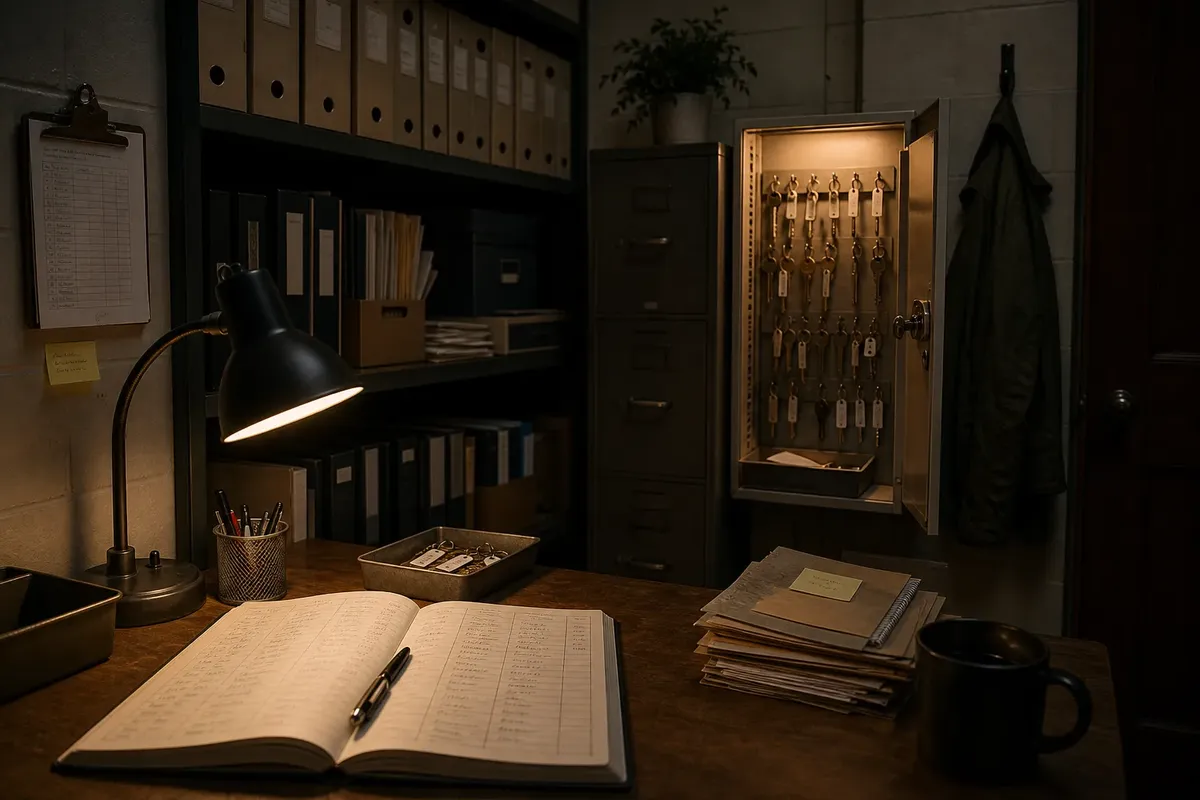
Say you have been asked to locate a missing set of room keys. The starting information is that the keys were last signed out for the west meeting room, but the return record is blank. You open the sign-out ledger, check the west-room entry, and note the borrower’s name. The observable result is a name and an unresolved return; your next decision is whether to contact that person or check the key cabinet first, depending on what the entry says.
The action should be small enough to begin, not so tiny that it becomes a ceremony. “Walk towards the cabinet” is observable, but rarely useful. “Check the cabinet’s return tray for the west-room key tag” gives the task somewhere practical to go.
What if the task is unclear or depends on someone else?
Some work cannot proceed until you know more. The next action is then the move that obtains the missing information, not a performance of certainty.
For instance, “Ask the building manager which cupboard holds the spare labels” may be complete if that answer is the blocker. If you do not yet know what is missing, “Compare the room list with the cupboard labels and note the mismatches” can make the uncertainty visible.
Keep the action within your control. “Get the keys returned” depends on another person; “Message the last recorded borrower and ask whether the keys were returned” describes what you can do. That distinction stops your task list from treating another person’s decision as your own pending action.
Does a clear next action need a strict schedule?
No. A next action is a starting cue, not a time slot. Choose it when you review your work, then begin when you have a suitable opening. This is useful when interruptions or changing demands make a rigid sequence unrealistic.
Nor does it mean reducing every task to a long chain of tiny instructions. Over-planning can become another way to postpone the work. Identify the first useful move, then decide what follows once you have new information or have completed it.
If the task has an obvious sequence, note an immediate follow-up when it is easy to forget. Otherwise, leave room to respond to what the first action reveals. A plan should remove avoidable choices, not judgement.
Which questions help clarify a next action?
How small should a next action be?
Make it small enough that you know how to begin, but meaningful enough to produce a visible change. If it still requires several fresh decisions, narrow it; if it is a trivial gesture, make it more substantial.
Should the action start with a verb?
Usually. Verbs such as find, compare, ask and send make the movement clearer. Pair the verb with a specific object or destination so “review” does not remain a vague instruction.
What if the first action changes after I begin?
Update the action to match what you have learned. A useful starting cue is allowed to expire; it is not a contract to follow an outdated plan.
Can a next action be a question?
It can be phrased as a question if it tells you what to investigate, such as “Which cupboard holds the spare labels?” For a task list, “Ask the building manager where the spare labels are kept” is often easier to start.
How can you tell whether the action is useful?
Look for less hesitation when you return to the task. If you can see it and begin without deciding what it means, the wording is probably useful. If you keep reopening the task to work out what to do, replace its label with a concrete move.
Keep the action near the task in a system you already use: a paper list, a notes app or the task field in your project tool. Avoid copying it into several places. The point is to make the next move easy to find, not to create a small administrative industry.
A clear next action makes starting easier because it carries the first decision out of the moment when you need to act. Use it for tasks that repeatedly stall, leave the rest alone, and revise the wording when circumstances change. The best cue is not the most elaborate one; it is the one that lets you begin without another meeting with yourself.