How to Plan a Workday Around Fixed Hours and Focus Time
Plan a workday around fixed hours by protecting the edges of your working day, setting a clear stopping point and choosing what fits the time left.
The common mistake in planning a workday around fixed hours is treating the official start and finish as the whole story. A commute, an opening routine or a hard stop to collect someone can make those hours less flexible than they look. Plan around the boundaries first, or the day begins with a quiet argument about time you do not have.
This is less about placing tasks in calendar gaps and more about deciding how work should fit inside a defined working day: when to begin, what must be ready before you start, and what to leave unfinished when the end arrives.
What are the real edges of your working day?
Write down the times you are expected to be available, then add the practical edges: travel, handover, opening a workspace, or shutting down shared equipment. A shift may begin at a stated time, but if the first task requires a briefing, that briefing is part of the working shape of the day.
Separate obligations from preferences. A scheduled appointment or agreed finish time is a constraint; a wish to answer every message before lunch is not. Marking the difference prevents an optional habit from quietly claiming the space needed for essential work.
Use the calendar for commitments that have a fixed time and a short list for movable work. The distinction is not a clever system. It is the difference between a door that must be opened at a certain time and a note reminding you to tidy the desk.
How should you set a start and finish routine?
A start routine should make the first useful action obvious. Check the day’s fixed commitments, open the file or tools needed for the main task, and note anything that must be handed over. Avoid beginning with a broad inbox sweep unless inbox management is itself the work you are responsible for doing first.
A finish routine should leave work in a condition you can return to. Save files, record the next action, note unresolved questions and tell colleagues when a response is needed. If work cannot be finished before the agreed end, identify whether it can move, be reduced or requires a conversation about scope.
These routines are boundaries, not ceremonies. Keep them short enough to survive an ordinary busy day.
How do you choose work that fits fixed hours?
Choose a main task with a visible finish point, such as sending a revised draft or preparing the agenda for a meeting. Then identify a smaller task that can be paused without losing its place. Keep less urgent work on the list rather than pretending every item has a rightful claim on today.
For each task, ask what must happen before it can be completed. If you are waiting for a colleague’s figures, send the request and choose independent work while you wait. If the task has no clear endpoint, define a next action that can be observed: open the document, mark the sections needing revision, or send a specific question.
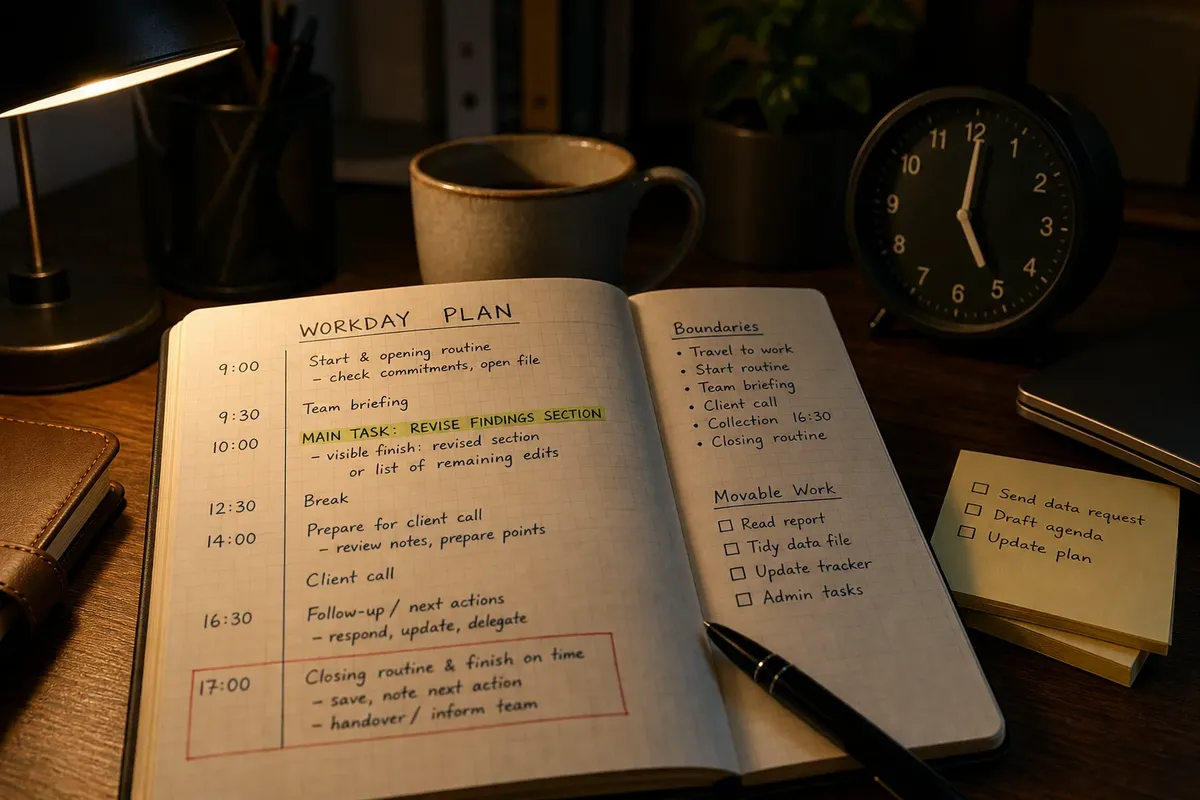
Say you have an invented workday that runs from 9.00 until 5.00, with a team briefing at 9.30, a client call at 2.00 and a firm collection commitment at 4.30. You enter the briefing and call, add the call preparation before 2.00, and protect the final half-hour for closing work and leaving on time. You choose “revise the findings section” as the main task and open the report after the briefing; the observable result is either a revised section or a note naming the remaining edits. If the call produces urgent follow-up, you use the post-call time for that work and move optional reading to another day. The trade-off is explicit: the report may need another session, but the fixed finish is not treated as imaginary.
What should you check before accepting another task?
Use the questions below to decide whether new work fits the day. Each check leads to an action; none requires a heroic calendar.
- If the request has a deadline before your working day ends, check what existing task would be displaced; if the displaced task is also essential, ask the requester or manager which takes priority, otherwise assign the new task a suitable place.
- If the work depends on information from someone else, check whether that information is available; if it is missing, send a precise request and switch to independent work, otherwise begin the task.
- If the task needs a quiet stretch, check whether your remaining time includes one; if it does not, divide the work into a preparatory action and a later focused session, otherwise use the suitable period.
- If a meeting or handover sits between work periods, check what must be ready before it; if preparation is needed, reserve time for that, otherwise use the interval for a task that can be paused.
- If the task’s finish point is unclear, check what visible output would count as progress; if none can be named, clarify the request before scheduling it, otherwise record that output as the target.
- If the work would run past your agreed finish, check whether the deadline or scope can change; if neither can, raise the conflict with the responsible person, otherwise move or reduce the work and record the decision.
What if the fixed hours keep changing?
When a shift, rota or caring commitment changes, update the boundaries before rearranging the task list. Tell people who rely on your availability what has changed, and ask which responsibilities still need to be covered. Do not silently extend the day to absorb a new constraint; that makes the plan look tidy while hiding the actual cost.
If interruptions are part of the role, identify the periods when you must monitor messages and the periods when another person can cover, if workplace arrangements allow it. Where safety, contractual duties or a colleague’s needs are involved, follow the relevant workplace rules and speak with a manager or qualified adviser when the arrangement is unclear.
What do people ask about planning a workday around fixed hours?
How do I plan a workday around fixed hours?
Enter fixed commitments and practical boundaries first, including preparation and handover. Choose a main task that fits the time left, then keep movable work on a separate list.
Should I work through lunch to catch up?
Do not treat a break as spare capacity by default. Follow workplace rules and consider whether the unfinished work needs a changed deadline, narrower scope or a conversation with the person assigning it.
How can I leave work on time when a task is unfinished?
Record what remains, the next action and any dependency, then tell the relevant person if the deadline or handover is affected. Agree whether the task moves, shrinks or needs additional support.
What should I do if my working hours change at short notice?
Update your availability and identify which existing commitments no longer fit. Ask the relevant manager or colleague to resolve competing duties rather than quietly carrying both as promises.
How should you close the day?
Before stopping, note what is complete, what remains and why it moved. Give unfinished work a concrete next action and a place to return to, if its timing is known. If the same task repeatedly runs beyond fixed hours, discuss its scope, dependencies or deadline with the person responsible for assigning it.
Planning a workday around fixed hours works best when the plan respects the end as well as the beginning. A clear stopping routine makes the next working session easier to enter, and it keeps an ordinary unfinished task from becoming an unspoken evening appointment.