The Three-Item Shortlist for a Crowded Task List
A three-item shortlist helps you choose meaningful work from a crowded task list by weighing deadlines, consequences and the time you actually have.
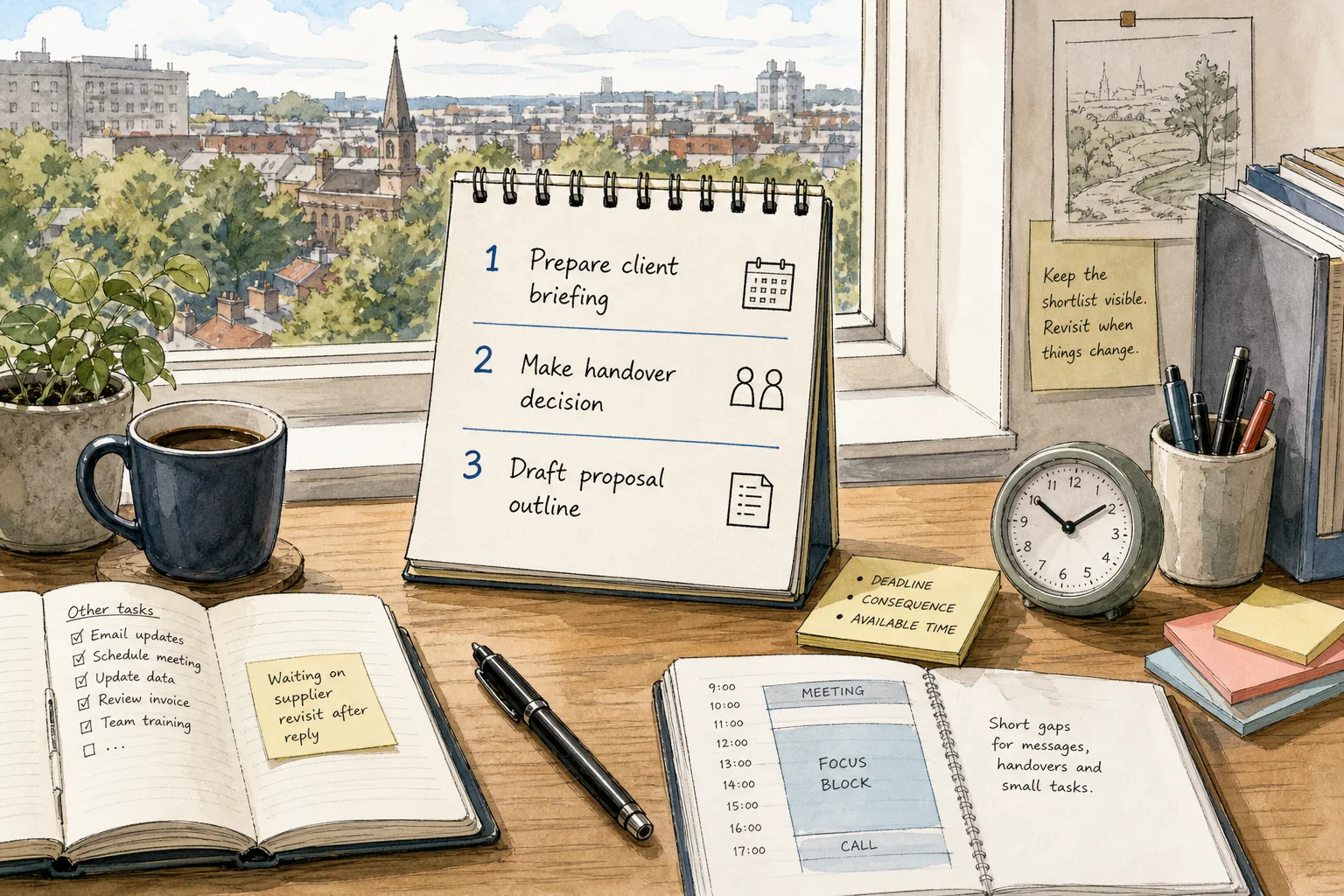
A three-item shortlist can turn a crowded task list into a workable decision: which tasks deserve a place in the day you actually have? The answer is not simply “the three most urgent”. A useful shortlist weighs deadlines, consequences and available time, then makes room for meaningful work without pretending every obligation can fit.
Three is a limit, not a productivity target. It keeps the day’s main commitments visible while leaving space for messages, handovers and the smaller jobs that rarely announce themselves. The method works best when you treat it as a decision about what to commit to, rather than a promise to finish everything on the page.
What belongs on a three-item shortlist?
Choose tasks that matter enough to shape the day, not every action that can be written as a verb. “Prepare the client briefing” may qualify; “send a quick reply” usually belongs in a smaller running list unless someone is waiting on it to act. One task can contain several actions, but it should have a clear result you can recognise.
Before choosing, look at three things:
- Deadline: When is the task due, and what must happen before that date?
- Consequence: What becomes harder, riskier or more disruptive if it waits?
- Available time: Can you make meaningful progress with the time and attention likely to remain?
These checks correct different kinds of bias. A distant deadline can still hide a serious consequence, while an item marked “urgent” may need only a brief response. A substantial task may be important but unsuitable for a day broken into meetings; you could instead define a bounded piece of it.
Should you sort by deadline, consequence or effort?
There are three useful ways to choose, each suited to a different kind of workday. None needs to be followed mechanically. The right approach is the one that reflects the real constraint you face, rather than the order in which tasks happen to appear on a screen.
When is a deadline-first shortlist useful?
Use this approach when a real due date or dependency is close. Check what is due, what must be ready beforehand and whether another person’s work depends on yours. It suits delivery days, scheduled approvals and commitments that cannot be moved without consequences.
When should consequences lead the choice?
Prioritise by consequence when a task has no immediate due date but neglect could create avoidable trouble. For instance, a small decision may unblock a colleague, while a familiar administrative task can wait. This approach suits roles where risks and dependencies matter more than the order of incoming requests.
When is a time-first shortlist more realistic?
Start with available time when the day is fragmented, your energy is limited or a task needs sustained attention. Choose work that can be completed, or advanced to a meaningful stopping point, within the space you can protect. This approach suits meeting-heavy days and tasks that can be divided into clear, useful stages.
Can the three approaches be combined?
Yes: use deadlines to identify constraints, consequences to compare the remaining candidates, and available time to decide what you can genuinely undertake. If one item dominates on all three, the choice is straightforward; if they conflict, decide which cost of delay matters most. A short conversation with a manager or affected colleague can help when the trade-off is theirs to make too.
How can you choose without overcommitting?
Say you have an invented, hypothetical situation: a report is due soon, a colleague needs a decision to continue a handover, and a draft proposal matters but has no near deadline. Your calendar has only one uninterrupted stretch, with short gaps elsewhere. You might shortlist the report, the handover decision and a defined proposal task such as outlining its main sections, rather than promising to complete the full proposal. The observable result should be a usable report, an unblocked handover and a proposal outline—not three vague intentions.
That distinction between a task and a task-sized outcome is important. “Work on the proposal” can expand to fill any amount of time; “draft the outline and identify open questions” provides a stopping point. If the day changes, you can still see what progress would count.
Before you commit, ask:
- Is the deadline fixed, or is it a preference that could be discussed?
- Who or what will be affected if this waits?
- Does this task require uninterrupted concentration, quick coordination or both?
- What portion can I complete in the time I can reasonably protect?
- What existing commitment would have to move if I add this?
The final question prevents a common trap: adding a new priority without naming what it displaces. If a fourth task seems essential, do not quietly squeeze it in. Decide which listed item should move, reduce the scope of one, or ask someone to help determine the trade-off.
What should happen to everything that does not make the list?
Leave unselected tasks visible, but separate them from the day’s commitments. A notes page, task manager or simple paper list can hold them; the important point is to give each item a sensible next status. Some are waiting on someone else, some have a later date, and some may be unnecessary once you examine them.
For tasks with uncertain timing, add a review cue rather than forcing a false decision. “Revisit after the supplier replies” is more useful than repeatedly reconsidering the same item. If a request is important to another person, tell them when you expect to return to it; silence can turn a reasonable delay into an avoidable interruption.
Keep the shortlist somewhere you can see it. A note beside your keyboard is like a small tray by the door: it does not remove the rest of the household, but it stops the next decision from being buried under everything else. When the day is disrupted, check the list again instead of treating the original plan as a contract.
How do you choose the right approach for your day?
Use the deadline-first approach when timing is the firmest constraint; use consequence-first when waiting could cause disproportionate difficulty; use time-first when the shape of the day limits what you can complete. Most days call for a blend, with one factor taking the lead. The three-item shortlist is useful precisely because it makes those trade-offs visible.
Revisit the shortlist when a meaningful change arrives, such as a deadline moving or a dependency breaking. Otherwise, leave it alone long enough to work. The point of choosing priorities is not to keep choosing; it is to give your attention a clear next destination while preserving a truthful account of what the day can hold.
A three-item shortlist is most effective when each item has a visible outcome, a reason it matters now and a realistic claim on your time. If you cannot name those three things, the task may need clarifying, renegotiating or breaking into a smaller piece before it earns a place.
Keep the thread going

A Flexible Weekly Plan That Leaves Room to Think
A flexible weekly plan helps you place work around real commitments, make transitions visible and keep…
The Paper Parking Lot for Thoughts That Interrupt
A paper parking lot for distracting thoughts gives stray ideas a place to wait, helping you…